G11–G12 A-Level Art & Design students with active ideas and uneven traditional drawing foundations.
UNDERGRADUATE THESIS · ACTION RESEARCH · 2026
AIGC in
A-Level Art
education.
Can generative AI help art students expand a personal visual language without replacing their judgement, process, or authorship? This study tests a three-stage teaching model inside a real A-Level studio.
《AIGC 在国际高中 A-Level 体系中艺术创作辅助教学研究》
01 Semantic divergence02 Logical critique03 Visual realisation
01 / THE TEACHING QUESTION
The barrier is not only technical.
The study identifies a double gap: when students have a narrow research field, their concepts often become visually homogeneous; when their visual ambition runs ahead of drawing confidence, they can stop before an idea has been properly tested.
The point of using AIGC is not to provide an answer image. It is to create a more visible space for proposing, questioning, and revising an idea while the student retains the final aesthetic decision.
02 / RESEARCH DESIGN
Action research
inside a real studio.
September 2025 to January 2026, through the core Personal Investigation phase of portfolio development.
Sketchbooks, prompt-iteration records, and post-lesson interviews read qualitatively with the Assessment Objectives.
03 / THE MODEL
Three stages of
human–AI work.
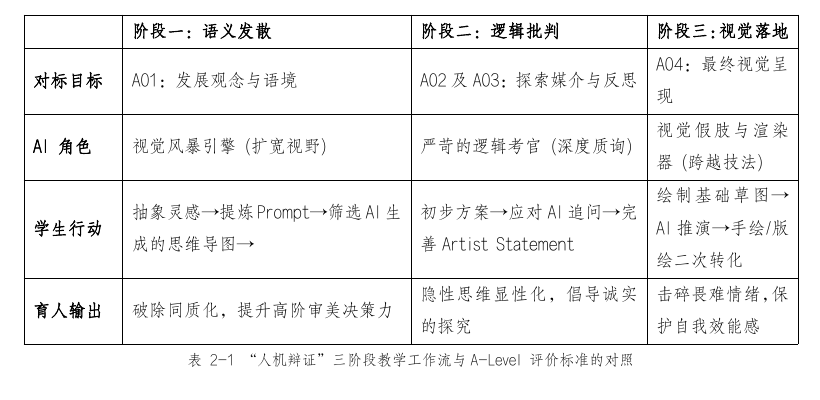
01 / AO1
Semantic divergence
Students translate an abstract concern into a specific metaphor, then use text-to-image exploration to compare visual contexts. In the paper’s example, “anxiety” moves toward melting flesh wrapped in plastic film. AI widens the visual starting field; it does not choose the work.
WHAT THE STUDENT MUST DO
Explain why a visual language, artist reference, or material relationship belongs to their own question.
02 / AO2–AO3
Logical critique
The student presents a tentative direction to an LLM configured as a demanding A-Level examiner. Questions about metaphor, narrative logic, cultural reference, and material choices make the Artist Statement something to revise, rather than a story written after the work is finished.
WHAT BECOMES VISIBLE
The exchange externalises reasoning and gives the sketchbook a defensible chain of decisions.
03 / AO3–AO4
Visual realisation
Students make a structural hand sketch, then use controlled image tools to test composition and difficult material effects. Original sketch, AI visualisation, and manual or digital reworking are kept together as evidence — never treated as a shortcut to a final outcome.
THE LEARNING LOOP
A lower-cost feedback loop lets students see a possible direction, then decide what deserves material testing in their own practice.
04 / THEORETICAL FRAME
AI as an external
cognitive scaffold.
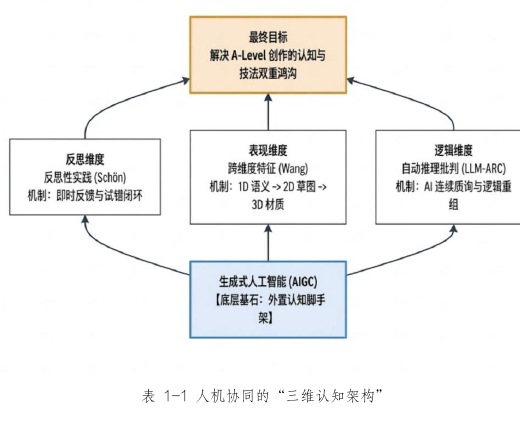
The study does not position AI as a drawing replacement. It uses three theories to explain another role: AI can hold part of the external cognitive load while students remain responsible for interpretation, selection, and making.
- Reflective dimension — Schön. Rapid input, observation and revision can create a shorter reflective loop.
- Representation dimension — Boden. Text semantics can be tested through visual and material possibilities across dimensions.
- Logical dimension — LLM-ARC. A language model can act as a reasoning critic that encourages self-correction.
05 / EVIDENCE & IMPLICATIONS
From execution
to judgement.
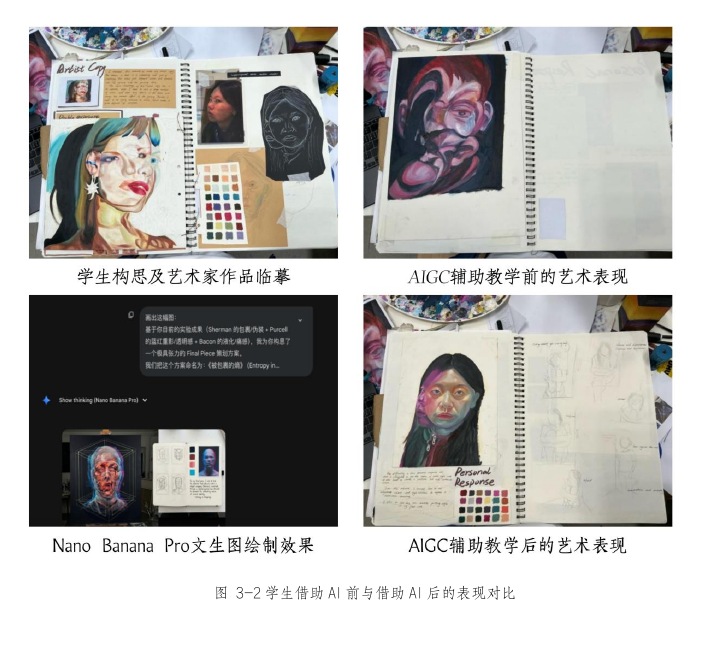
Case: Entropy in Wrappings
This A-Level project considers the collapse of modern personas under digital disguise. The student brought together Cindy Sherman’s social metaphor, Francis Bacon’s spatial pressure and liquefied body, and Shannon Purcell’s cyber-filter language — a difficult combination to test through conventional painting alone.
AI-assisted trials were used to explore black-and-white contrast, texture, and cross-media relationships. The claim is not that AI made the outcome; it made a complex proposal visible enough for the student to evaluate, translate into material decisions, and document as a process.
AO1AI-supported research expanded the project’s visual
and contextual field.
AO2Visual trials lowered the cost of testing material and
compositional relationships.
AO3Prompt history, image selection, sketching, and
reflection formed a visible evidence trail.
AO4The final response could be justified through
accumulated process, not retrospective narration.
Protect creativity.
Visual feedback can
reduce learned helplessness when a student’s conceptual ambition
outruns current technical confidence.
Raise the level of thinking.
Students
compare, explain, curate, and revise — moving from technical
execution toward aesthetic decision-making.
Make inquiry honest.
Keeping the process
record makes AI use explicit, instead of hiding generation or
fabricating a process afterward.
READ THE COMPLETE STUDY